
Number of views: 2183 Author: Aili Industry Release time: 2026-09-29 Source: Ai Li Industrial
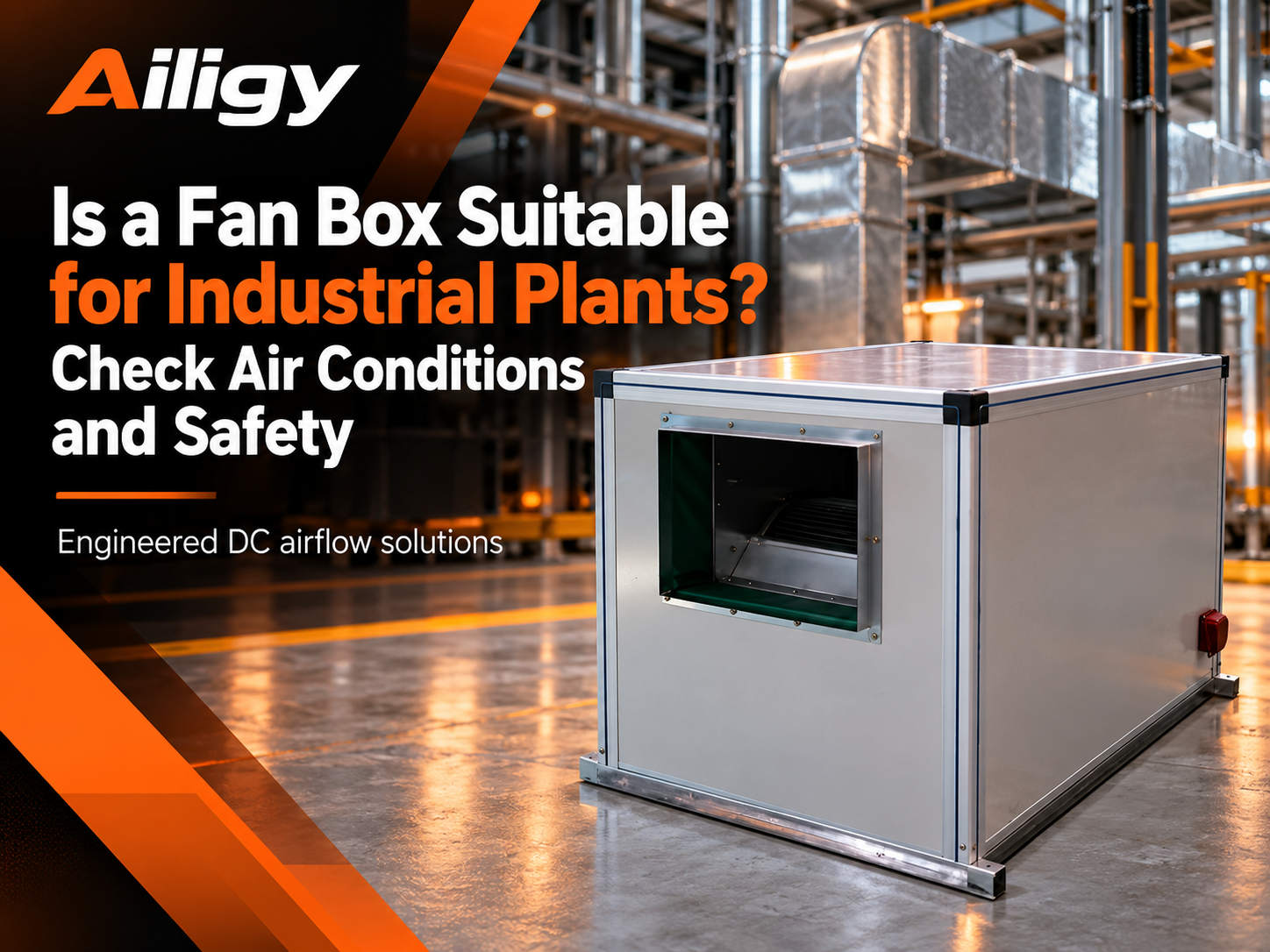
There is nothing wrong with the statement that fan boxes can be used in industrial plants. However, there are several layers of information between the words 'industrial plant' and 'fan box'. Is the factory supplied with ordinary indoor air, or air with dust, corrosiveness, or oil mist? Is it conventional ventilation, equipment heat dissipation, or process exhaust? If these conditions are not confirmed first, the selection will not proceed.
The biggest difference between industrial plants and ordinary office buildings is that there may be things in the air. There is smoke and dust in the welding workshop, oil mist in the machining workshop, corrosive gases in the chemical workshop, and solvent vapor in the spray painting room. The requirements of these media on the fan box are completely different from those for ordinary indoor air.
Ordinary carbon steel cabinets may rust through in a few months in a corrosive environment. When ordinary motors are in a dusty environment, the heat sink is covered with dust and the temperature rise quickly exceeds the standard. If flammable and explosive gases are transported, the electrical equipment also needs to meet the corresponding explosion-proof level. These are not problems that can be solved by 'choosing a larger size', but the structural plan itself needs to be changed.
Therefore, when selecting an air box for an industrial plant, the first thing to confirm is not the air volume, but the air composition. Temperature, humidity, dust content, corrosiveness, and flammability, these data must be obtained first. After getting it, we can judge whether the ordinary carbon steel box and ordinary motor can be used, or whether we need to replace it with stainless steel, add anti-corrosion coating, and change the explosion-proof motor.
Industrial plants often have purification needs, such as welding smoke control, spray paint room exhaust air purification, and dust workshop return air filtration. In this case, can a filter be added directly to the fan box?
Can be added. The fan box can reserve a filter section in the box and configure primary, medium or high-efficiency filters to form a purified air box. Coarse-efficiency filtration intercepts large particles, medium-efficiency filtration handles fine dust, and high-efficiency filters are used in situations where cleanliness is required. The specific levels and levels to match depend on the air medium and emission requirements.
But adding a filter is not as simple as 'adding a network'. The filter itself has resistance, the initial resistance is tens to hundreds of Pa, and the final resistance may be two to three times the initial resistance. This resistance must be factored into the operating point of the fan box. If the fan is selected according to the working conditions without a filter, the air volume may drop directly after the filter is installed. The length of the fan box should also be increased accordingly to leave room for installation and replacement of the filter section.
Aili Industrial has independent supporting capabilities in fans, motors, controls and sheet metal structures. The installation space, air flow channels and access openings for the filter section inside the box can be considered at the design stage. There is no need to figure out how to plug the filter after the box is completed. The matching relationship between the fan and filter can be checked from the whole machine level, which is more reliable than installing it afterward.
In the filtration section of industrial plants, the resistance is not a fixed value. The new filter material has initial resistance when it is installed. After running for a period of time, dust accumulates and the resistance gradually increases. If the fan box is selected based on the initial resistance, the air volume may not be enough after a few weeks of operation.
When selecting the model, the working point should be calculated according to the final resistance, and the motor and driver should be confirmed to have margin to cope with the increase in resistance. If speed control is adopted, the speed can be adjusted according to the filter pressure difference signal, and when the resistance rises, the speed can be appropriately increased to maintain the terminal air volume. However, there is an upper limit to the speed increase, and the motor power and drive capacity must be reserved in advance.
If the system is configuredFor HEPA/ULPA high-efficiency filters , the initial resistance and post-use resistance of the filter should be included in the calculation of the working point. When the process requirements are higher, it can be evaluatedDoes the ULPA ultra-high efficiency filter meet the requirements?
The uses of fan boxes in industrial plants can be roughly divided into three categories. General ventilation focuses on overall air exchange and noise. The direction of the air duct and the space of the computer room determine the form of the box. For equipment heat dissipation, the local air volume and interface size must be checked. The fan box may be installed close to the equipment and the space is limited. Process exhaust depends on the medium. Exhaust containing dust, oil mist, and corrosive gases has completely different material and sealing requirements.
Using 'industrial plant' as the only selection criterion is equivalent to saying nothing. In the same workshop, the exhaust fan box for the welding station and the supply fan box for the office may have two completely different configurations from the box material to the motor protection level.
Industrial plants sometimes involve special safety conditions. Spraying workshops, solvent warehouses, and dust explosion hazardous areas have explosion-proof requirements for electrical equipment. High-temperature flue gas emissions require fans and motors to operate continuously at high temperatures. Under these conditions, the fan box cannot be directly applied to conventional products.
When confirming safety requirements, it is necessary to clarify the division of hazardous areas, the explosion level of gas or dust, and the ambient temperature range. The supplier selects the motor protection level, wiring method, control components and protection devices accordingly. If the project itself involves explosion protection or high temperature, this should be stated at the inquiry stage rather than waiting for the equipment to arrive to discover the problem.
The hoisting path, air duct direction, power supply location and maintenance space of an industrial plant are often more critical than whether the box can be put down. In a continuously running production line, once the fan box is shut down, production will be affected, and sufficient maintenance channels must be left. Filters need to be replaced regularly, and the replacement path cannot be blocked by air ducts or equipment. The motor and driver need to be checked, and the access door must be able to be fully opened.
These conditions are confirmed at the drawing stage, which is more cost-effective than dismantling and modifying after installation. Aili Industrial can provide equipment drawings, basic conditions and interface directions according to the project, and complete the drawing confirmation before shipment to reduce cooperation problems during the on-site installation stage. Specific structure and configuration options can be found inIt is confirmed in the fan box product catalog that non-standard projects should provide equipment or machine room drawings, and then shape them based on the determined working points and on-site interfaces.
Clean room ceiling air supply is comparableFFU fan filter unit ; centralized management of multiple devices can be matchedThe FFU computer group control system realizes zone speed regulation and status monitoring. Protection of single process equipment can be consideredEquipment-side fan filter unit (EFU) . The final filtered air supply at the end of the air duct can beHigh-efficiency air supply outlet (HEPA BOX) . The division of labor between these equipment and the fan box should be clearly stated on the system flow chart.


