


From the overall air supply of clean rooms to local clean air needs inside production equipment, Aili Industry provides products and supporting components. The corresponding category can be selected according to the installation location, target air volume, filtration requirements and control method.

Air supply from clean room ceilings, clean sheds and local clean areas.

Select according to efficiency level, structural form and system resistance.
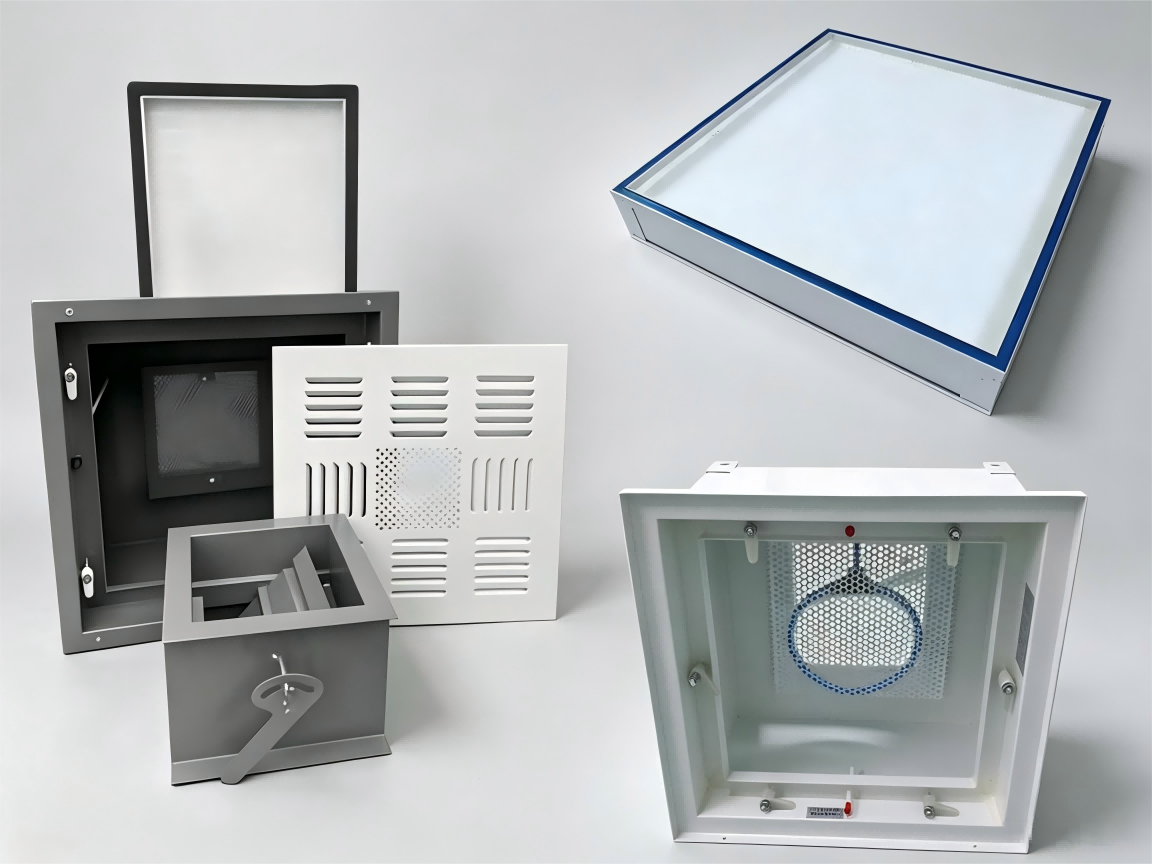
The end filtration and air supply of the clean room supports a variety of air inlet and sealing structures.


Clean air supply inside semiconductor, SMT and automation equipment.

Configured according to target gaseous pollutants and application conditions.

For new construction and renovation projects of air supply systems such as air conditioners.

FFU group control, BFU and other clean air equipment supporting equipment.


Aili Industrial has a 30,000 square meter manufacturing base, and its R&D and manufacturing system covers motors, fans, control system software and hardware, air filters, sheet metal processing and complete machine assembly. When there are requirements for wind speed, uniformity, space or control interfaces in the project, the company's own motors, fans, control system software and hardware, filters and equipment engineers will participate together to check the component configuration and complete machine design in the same plan.


Motors, fans, control system software and hardware, filters, sheet metal and the complete machine are internally connected, providing a manufacturing basis for non-standard and batch matching.

Relevant engineers jointly checked the power, air path and box configuration around the target wind speed, uniformity, filtration resistance and space.

Combining equipment signals, communication and operation modes, control and equipment personnel jointly confirm the interface and adjustment logic.

Communicate drawings, component parameters and prototype changes directly internally, reducing the need for multiple translations and separate confirmations.

Combined with performance configuration, processing assembly and maintenance conditions, unnecessary configuration, interface rework and repeated modifications are reduced.
Combined with the on-site working conditions, the company's internal R&D personnel jointly analyze control, power, filtration and structural issues, respond quickly, and discuss targeted adjustments.

The internal space of EFEM equipment is compact, and FFU needs to meet the internal clearance, air circulation path and cleanliness level requirements. The EFEM microenvironment usually requires high cleanliness, and the FFU layout needs to be coordinated with the wafer handling mechanism, return air path, and pressure control. This article explains space verification, airflow organization, and cleanliness levels, and organizes project verification data and on-site judgment points. Aili Industrial has complete production capabilities in terms of FFU complete machines and equipment-end supporting equipment, and can provide ultra-thin or customized air supply solutions based on the internal structure of EFEM. Welcome to contact Aili Industrial for project support.
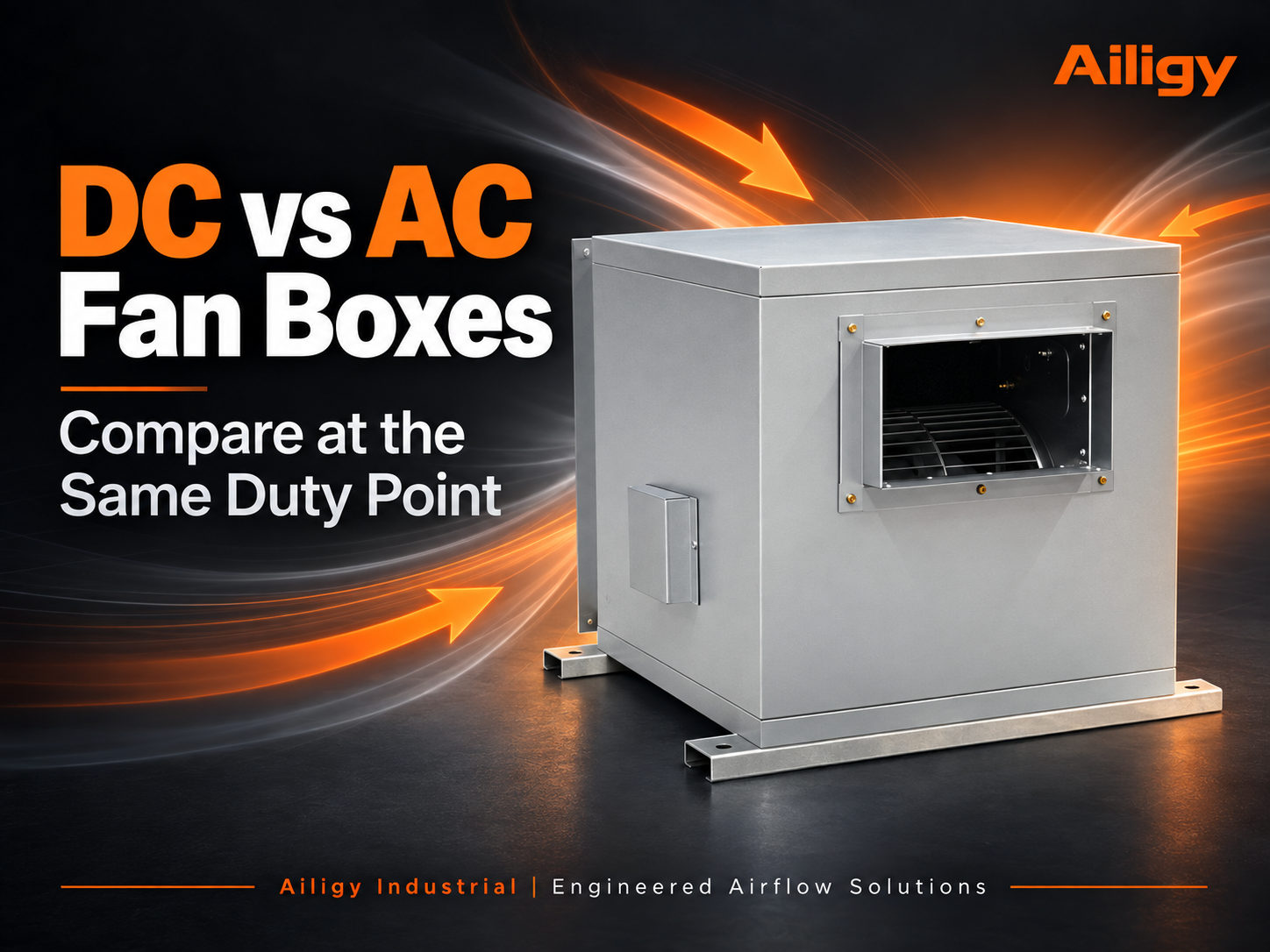
Comparison between DC and AC fan chassis should be done under the same air volume, static pressure and operating time, focusing on checking the overall machine power, speed adjustment method, control interface and maintenance conditions. If the old equipment on site relies on valve throttling for a long time, first measure the actual terminal air volume and pressure before discussing modification. The difference usually appears in the control strategy and operating mode. AC frequency conversion can also adjust speed, and the DC solution does not naturally save power. The procurement conclusion should list the power supply, control protocol, operating point, noise, box interface and total investment in the same comparison table, and indicate the test conditions. Aili Industrial has the ability to independently support fans, motors, controls and sheet metal. It can calibrate impellers, motors, drives and cabinets at the same working point, and provide complete machine test data according to project conditions, allowing comparisons between DC and AC to be based on verifiable complete machine data.
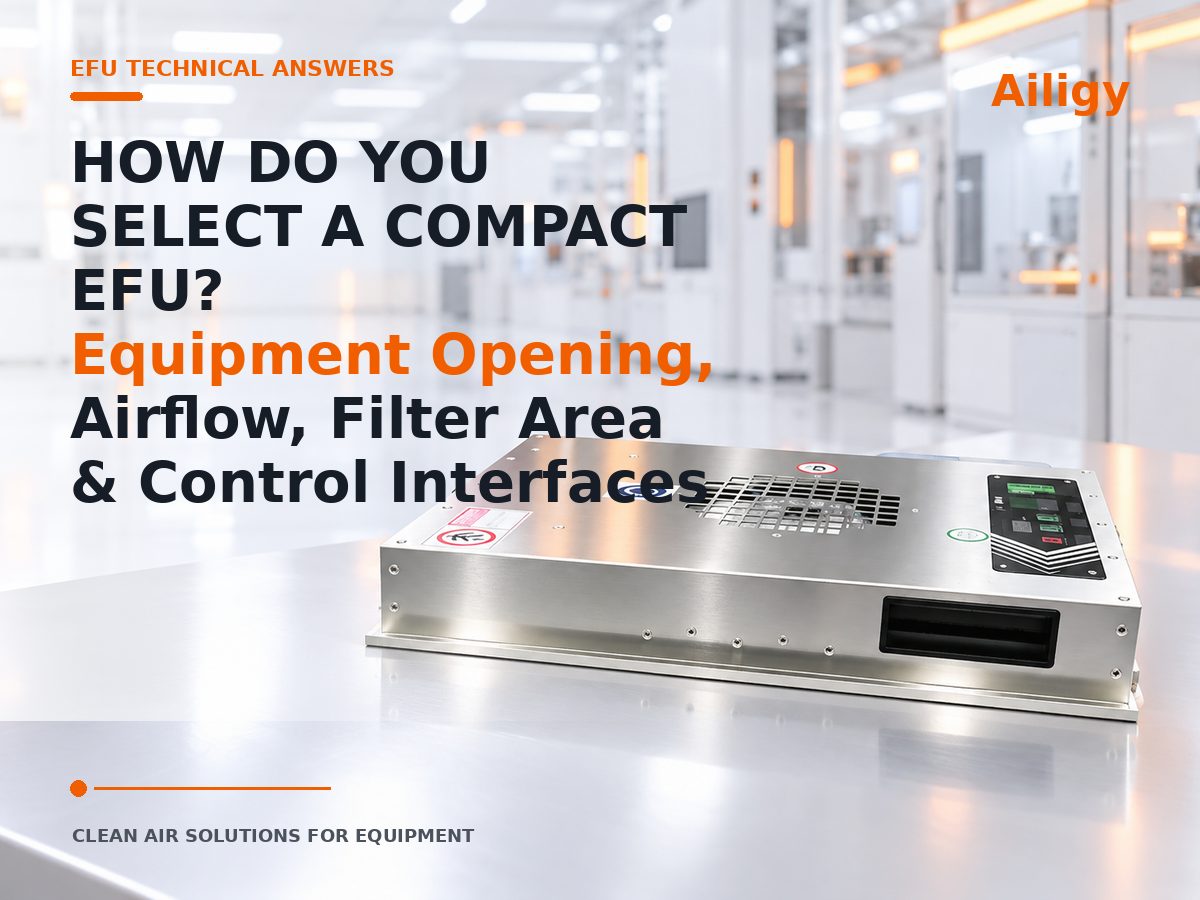
This article focuses on the selection method of small-size EFU, and proposes that the four key points of equipment opening, target air volume, filtration area and control interface should be reversely confirmed instead of selecting standard products first. The article explains that the opening of the equipment determines the outer boundary of the box. The air volume needs to be confirmed according to the target area and system resistance. The filtration area directly affects the surface air speed, resistance and filter life. The control interface determines whether it can be linked with the equipment system. It also lists common selection misunderstandings and configurations of different equipment scenarios. direction, and also recommends related product pages such as Aili Industrial small-size EFU, ultra-thin EFU, DC EFU, snap-on EFU, SMT placement machine EFU, anti-static EFU, 86-type controller and customized EFU to facilitate users to further select according to application scenarios.

The focus of configuring EFU for lithography equipment is not to simply increase the air volume, but to establish stable, well-directed and verifiable local clean airflow around sensitive areas such as wafer transportation, positioning, and detection. The article introduces the design method from the aspects of pollution path, air supply boundary, wind speed uniformity, spatial interface, filtration configuration and equipment linkage.

HEPA and ULPA are the two most core terminal air filters in clean rooms. The core difference between the two lies in filtration accuracy and applicable scenarios. HEPA (High Efficiency Filter) has a filtration efficiency of 0.3μm particles ≥99.97%, corresponding to H13/H14 levels, and is suitable for ISO 5-9 clean environments. Typical applications include pharmaceutical workshops, hospital operating rooms and food processing. ULPA (ultra-high-efficiency filter) has a filtration efficiency of 0.12μm particles ≥99.9995%, corresponding to U15/U16 levels, and is suitable for ISO 1-4 ultra-high clean environments. Typical applications include semiconductor lithography and biosafety laboratories. The purchase cost of ULPA is about 2.5-3.5 times that of HEPA, and the initial resistance is about 30% higher. The selection should be based on a comprehensive judgment based on the actual cleanliness level requirements, process sensitivity and system compatibility. Not all scenarios require ULPA - H14 level HEPA for ISO level 5 (level 100) clean rooms fully meets the standards.

The main difference between high-efficiency filters with partitions and high-efficiency filters without partitions is the filter material separation structure. Filters with partitions use corrugated partitions to support the filter material, while filters without partitions use glue lines or other separators to form filter channels. Both can be used in different clean air filtration systems depending on specific product configurations. The actual selection should not only look at the structure, but also need to comprehensively consider the filtration efficiency, system air volume, initial resistance, filter size, installation space and usage environment. For different applications such as clean rooms, HVAC, FFU, EFU and semiconductor equipment, the appropriate filter structure should be selected based on the project parameters. Aili Industry can combine high-efficiency filters, ULPA, FFU and EFU products to provide customers with corresponding air filtration product configuration and selection support.
 Landline
mobile phone
 e-mail
 address


