
Number of views: 5011 Author: Aili Industry Release time: 2026-09-28 Source: Ai Li Industrial
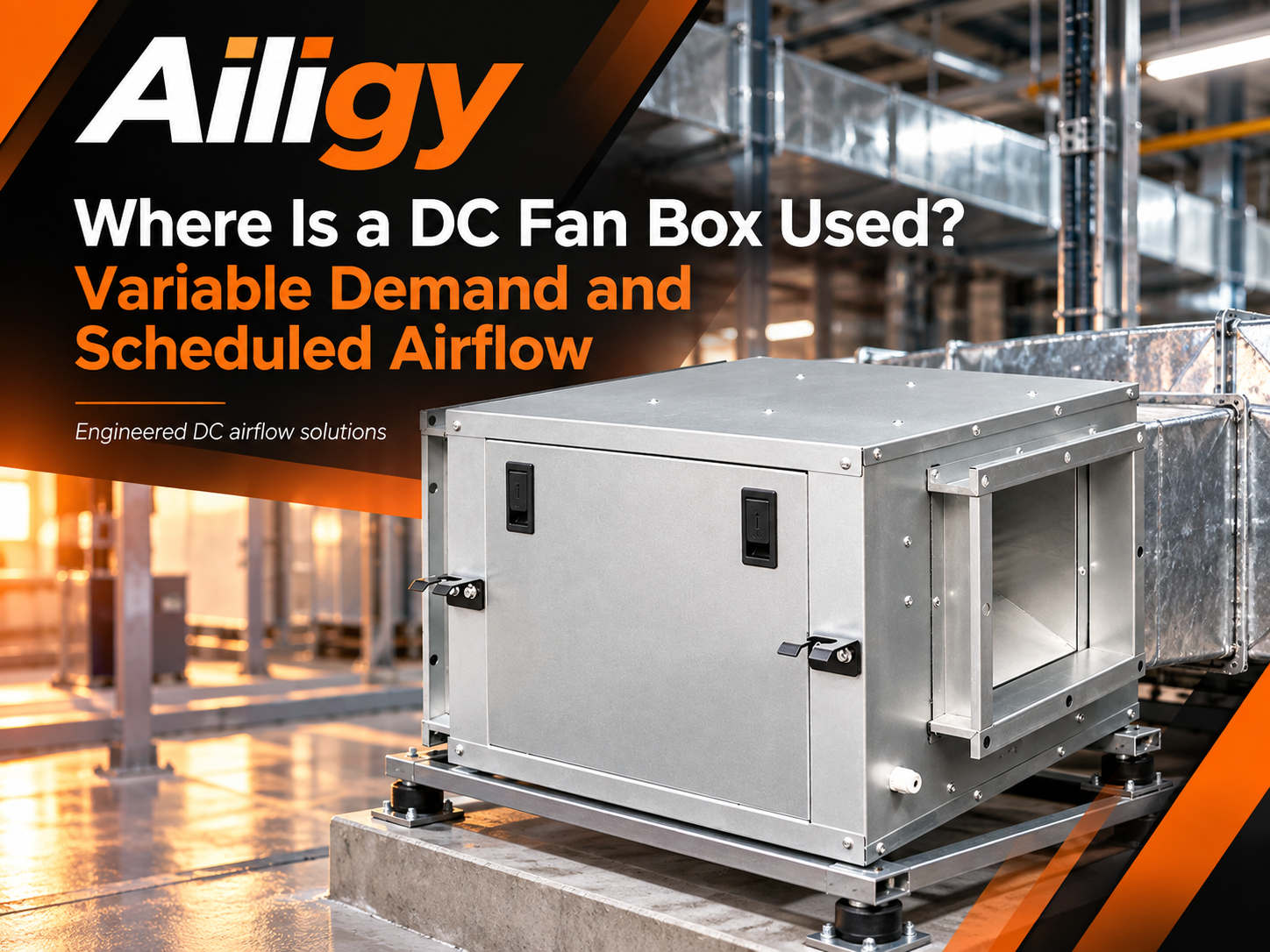
Direct answer: DC air box is mainly used for air supply and exhaust systems that need to adjust the air volume on demand. It is not an exclusive product for a certain industry, but a power solution: when the system is not running at full load all day long, or there are significant differences in air supply demand in different areas and periods, DC speed regulation can allow the fan output to follow the actual demand changes. The specific suitability still depends on the design air volume, external static pressure, operating period and on-site electrical conditions.
Aili Industry is discussingDC fan cabinets , we usually first understand the load change pattern of the project, rather than first asking which industry the customer belongs to. When using Because in the same industry, the control requirements for the total air supply that runs constantly throughout the day and the equipment air supply that switches by shift are completely different.
The air supply requirements of many projects are not in a straight line. The day shift and night shift loads in the production workshop are different, the working hours and non-working time requirements of the office area are different, the equipment is only turned on during part of the period, and the operation mode of the air conditioning system is also different in the transition season and summer. Under these circumstances, the fan box operating at a fixed speed either continues to supply air according to the maximum demand, resulting in excessive air supply during low load periods; or it operates according to average demand and fails to meet the requirements during peak periods.
The value of the DC fan case appears here. It can switch the speed according to the preset working mode: operate according to the design working conditions during production periods, reduce the air volume at night or during duty periods, and only maintain necessary air exchange or pressure difference. After reducing the speed, the input power of the whole machine usually decreases, but the specific energy saving depends on the load curve, system resistance characteristics and speed regulation strategy. You cannot promise a fixed power saving ratio based on the word 'DC'.
If the system operates at full load for a long time, the advantage of the DC solution mainly comes from the motor efficiency itself; if there is an obvious partial load period, the benefits brought by speed regulation will increase significantly.
In addition to changes in the time dimension, differences in the spatial dimension can also be managed using DC speed regulation. For example, multiple areas share a fan box, and different areas have different usage times, or some branches will be closed at different times. When one branch is closed and the other branches remain open, the fan operating point will change. If there is no speed adjustment capability, it can only be adjusted by valve throttling. The fan is still running at high speed, and the excess air volume is consumed by the valve.
The DC fan box can adjust the speed in combination with the control signal, so that the total air volume is close to the demand of the actual opening area. However, it is important to note that reducing the RPM will also change the pressure available. For multi-branch systems, the required air volume or pressure difference should be verified at the most unfavorable end. Only seeing a decrease in current cannot prove that the entire system still meets the usage requirements. Sensor position and branch balance are equally important. Speed adjustment based only on one measuring point may result in insufficient air volume in the remote area.
For new projects, air ducts, fan boxes and automatic controls can be determined simultaneously during the design phase. Speed control signal types, terminal definitions, communication protocols and fault feedback methods can all be planned uniformly at the drawing stage. Control cabinet space, drive cooling and cable routing can also be arranged in advance to avoid interface conflicts later.
The renovation project was limited by the original foundation, power supply and control cabinets. It is necessary to first take inventory of the original control signal type, power supply capacity, flange size and maintenance space. If the original system uses analog control, is the new driver compatible? If the original system only has start-stop control, does it need to add a speed control signal line? If the original control cabinet does not have space to install the driver, does it require an external control box. These issues must be confirmed before modification.
Renovation projects should also first measure the air volume, pressure and input power of the original system under actual operating conditions. When old equipment relies on valve throttling for a long time, its nameplate power does not represent actual demand. The new solution should meet the usage requirements and retain a reasonable margin, rather than directly copying the rated maximum value of the old equipment.
When the DC fan box serves a clean or air-conditioning system, the end of the system may be configuredHEPA/ULPA high efficiency filter . The initial resistance of the filter and the resistance at the end of use should be included in the calculation of the working point. If the filter resistance increases with dust accumulation, the speed adjustment strategy should be adjusted accordingly to ensure that the terminal air volume does not decrease due to the increase in resistance. When the process requirements are higher, it can be evaluatedDoes the ULPA ultra-high efficiency filter meet the requirements?
If the project requires direct filtering of air supply from the top of the equipment,FFU fan filter unit may be another structural option. FFU combines a fan and a high-efficiency filter, has its own power and modular installation, and is suitable for ceiling air supply in large-area clean rooms. When multiple FFUs need to be managed in a unified manner, they can be matchedThe FFU computer group control system realizes centralized speed regulation and status monitoring.
If the core requirement is to protect the machine microenvironment of a single process equipment, rather than the entire clean room, thenAn equipment-side fan filter unit (EFU) may be more suitable than an FFU. EFU is specially designed for local purification at the equipment end. It is more compact and can be installed directly at the air inlet of the equipment. When final filtration and uniform air supply are required at the end of the air duct, you can also consider usingHigh-efficiency air supply outlet (HEPA BOX) . The division of labor boundaries between these devices and the DC fan box should be clearly drawn on the system flow chart.
To determine whether a DC fan enclosure is suitable for a project, at least the following information should be provided:
Design air volume and common air volume correspond to the external static pressure respectively.
Daily and yearly operating periods, whether there are different modes of work, duty, etc.
Terminal requirements under different modes, including air volume or pressure difference requirements at the most unfavorable terminal
Power supply conditions, including voltage, frequency and control cabinet space reserved
Speed control signal type, analog, PWM or communication
Do you need running feedback and fault alarms?
Installation space and maintenance conditions
Whether there is a filter at the end of the system, the filter grade and the expected range of resistance changes
These data determine whether the DC fan chassis can cover the actual working point and whether the control interface can be connected to the on-site system. Just write 'need speed adjustment' or 'need energy saving', and the supplier cannot judge whether the solution is feasible.
Aili Industry can discuss according to air volume, external static pressure, operating time and control interface.DC fan chassis configuration . If the core requirement at the end is local clean air supply inside the equipment, you can compareThe structure of the equipment-side fan filter unit (EFU) . Specific configuration options can be found inIt is confirmed in the fan box product catalog that non-standard projects should provide equipment or machine room drawings, and then finalize them based on the determined working points and on-site interfaces.


