


| FAQ classification | Main questions answered |
| Basic knowledge and product comparison | What is a chemical filter? What is the difference between activated carbon, HEPA, ULPA and other purification methods? |
| Pollutant identification and gas filtration | How to identify the source of gas? How should acid gas, ammonia, amines, organic gases and odors be dealt with? |
| Filter material parameters and selection configuration | How to compare filter media, efficiency, capacity, penetration, air volume, size and resistance? |
| MAU, FFU and equipment side matching | How to divide the work between fresh air, circulating air and equipment-side chemical filtration, and how to match the installation and fans? |
| Industry applications and clean environment | How to determine filtration requirements for semiconductor, panel, optics, electronics, computer room and medical projects? |
| Installation testing and effect acceptance | How to confirm the air flow direction, sealing, bypass, sampling and trial effects? |
| Lifetime maintenance and troubleshooting | When will it be replaced? How to judge pressure difference, odor, outlet concentration and operating abnormalities? |
| Renovation energy saving and operating costs | Can the original system be retrofitted? Does the fan need to be adjusted, and how do you compare the long-term costs? |
| Program decision-making and manufacturer selection | How to deal with multiple pollutions in combination? How to check manufacturer recommendations, product information and supporting capabilities? |
| Compare items | chemical filter | HEPA filter | ULPA filter |
| Main control objects | Specified gaseous pollutants | Corresponding particulate matter | Corresponding particulate matter |
| Main processing mechanism | Adsorption or chemical reaction, etc. | particle capture | particle capture |
| Key points in selection | Gas composition, efficiency, capacity, environment and air volume | Particle efficiency, air volume, resistance and sealing | Particle efficiency, air volume, resistance and sealing |
| Effect judgment | Corresponding gas detection and applicable capability assessment | Corresponding particle performance and installation testing | Corresponding particle performance and installation testing |
| Can they be substituted for each other? | One type of filter cannot replace another type of task | Tongzuo | Tongzuo |
| Application scenarios | Main needs | Selection points of concern | System supporting direction |
| Semiconductor and wafer fab | Process Dependent AMC Control | Sensitive ingredients, low concentration targets and detection capabilities | Fresh air, circulating air and equipment end protection |
| Panels and precision optics | Related gas and material release controls | Material sources, air paths and clean compatibility | Air conditioning system, local circulation and equipment matching |
| Electronics and Data Center | Related Gaseous Corrosion Pollution Control | Equipment environmental requirements, temperature and humidity and monitoring trends | Fresh air or circulation system |
| Pharmaceutical and packaging area | Designated gas and external odor control | Source identification, regional division of labor and product protection | Fresh air, regional ventilation and local treatment |
| General factory buildings and air conditioning systems | Reduce specific gas input or odor | Composition, loads, ventilation conditions and operating costs | Air conditioning box, filter box or zone treatment |
| Selection conditions | What needs to be confirmed | Selection conditions | What needs to be confirmed |
| target gas | Specific ingredients, single or mixed contamination | Processing air volume | Total air volume, single module air volume and actual distribution |
| inlet load | Concentration range, peak value and frequency of occurrence | Temperature and humidity | Normal ranges, seasonal variations and condensation risk |
| Source of pollution | Outdoor, indoor materials or inside equipment | Fan margin | Added air volume and operating capacity under resistance |
| protection goals | Process, product, preservation or deodorization | Installation interface | Dimensions, orientation, sealing, compression and support |
| performance basis | Test conditions and reports for corresponding gases | maintenance conditions | Operating hours, replacement space and spare parts |
| Acceptance requirements | Methods, points, working conditions and criteria | cost of use | Energy consumption, replacement frequency and maintenance workload |
| Supporting location | Main function | Conditions to watch out for |
| MAU or air conditioning box | Reduce the load of external gas entering the system | Fresh air composition, temperature and humidity, droplets, air volume and filter section position |
| FFU circulated air | Process the relevant gases that pass through the filter section | Circulation path, wind speed, resistance and particle filtration coordination |
| EFU or device side area | Provide matching gas filtration for designated local areas | Equipment space, internal releases, airflow coverage and maintenance interfaces |
-
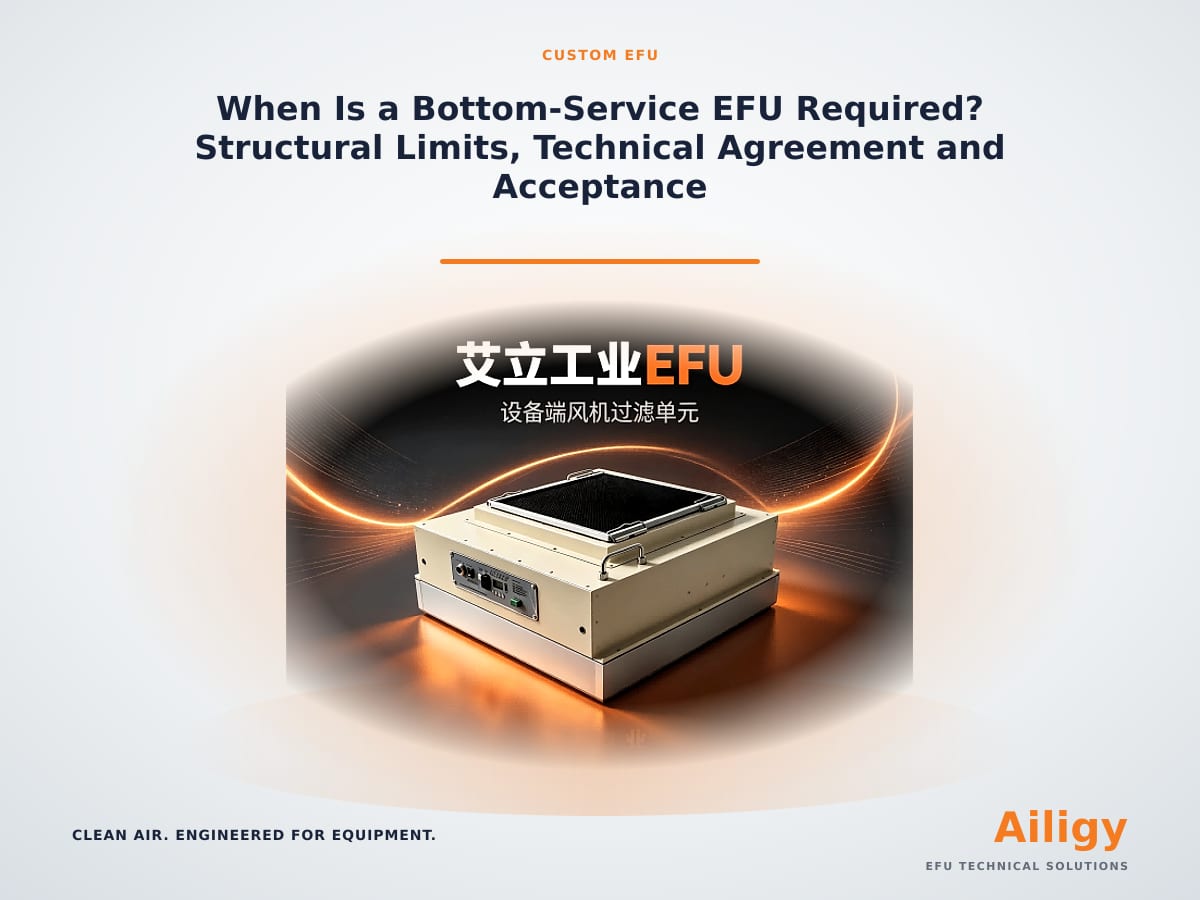 This article focuses on 'When does the drop-down EFU need to be customized?' It explains the judgment method of whether customization is needed, structural boundary freezing, technical agreement, sealing structure, prototype verification and acceptance points, and gives the key points of drawing confirmation, prototype testing and batch curing for direct verification by equipment design, procurement and maintenance personnel. Ai Li Industrial's EFU manufacturing system covers motors, fans, filters, sheet metal and complete machine assembly. The structure, sealing and complete machine performance of the detachable EFU can be checked according to the equipment drawings in the same system. When customizing the detachable EFU, you can refer to the structure and performance supporting instructions provided by Ai Li Industrial according to the model.
-
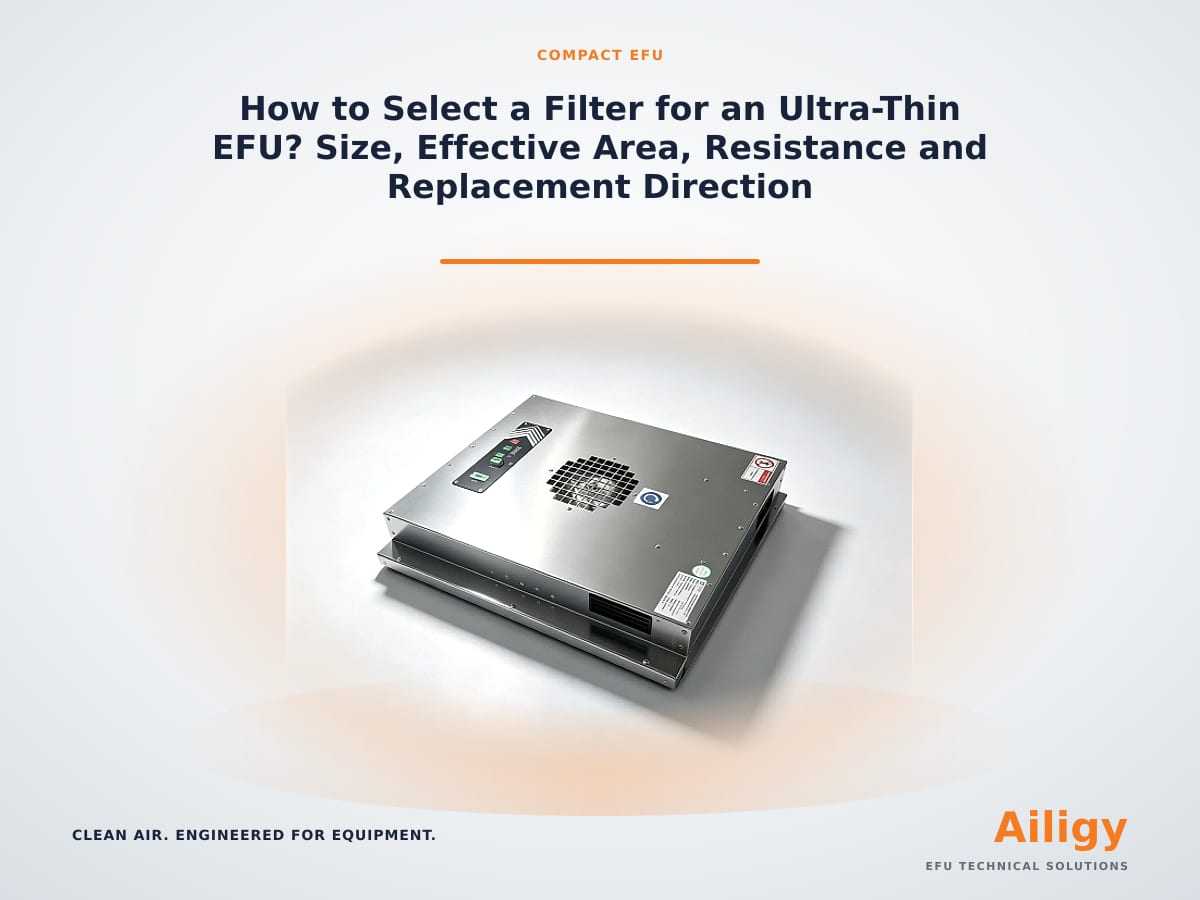 This article focuses on 'How to choose ultra-thin EFU filters' and explains the judgment method of size matching, effective area, resistance, sealing method, replacement direction and complete machine matching. It also provides drawing confirmation, prototype testing and batch curing suggestions for direct verification by equipment design, procurement and maintenance personnel. Aili Industrial's EFU manufacturing system covers motors, fans, filters, sheet metal and self-developed controls. The size, area, resistance and replacement direction of ultra-thin EFU filters can be checked according to equipment drawings in the same system. When selecting ultra-thin EFU filters, you can refer to the instructions provided by Aili Industrial for filter and complete machine matching by model.
-
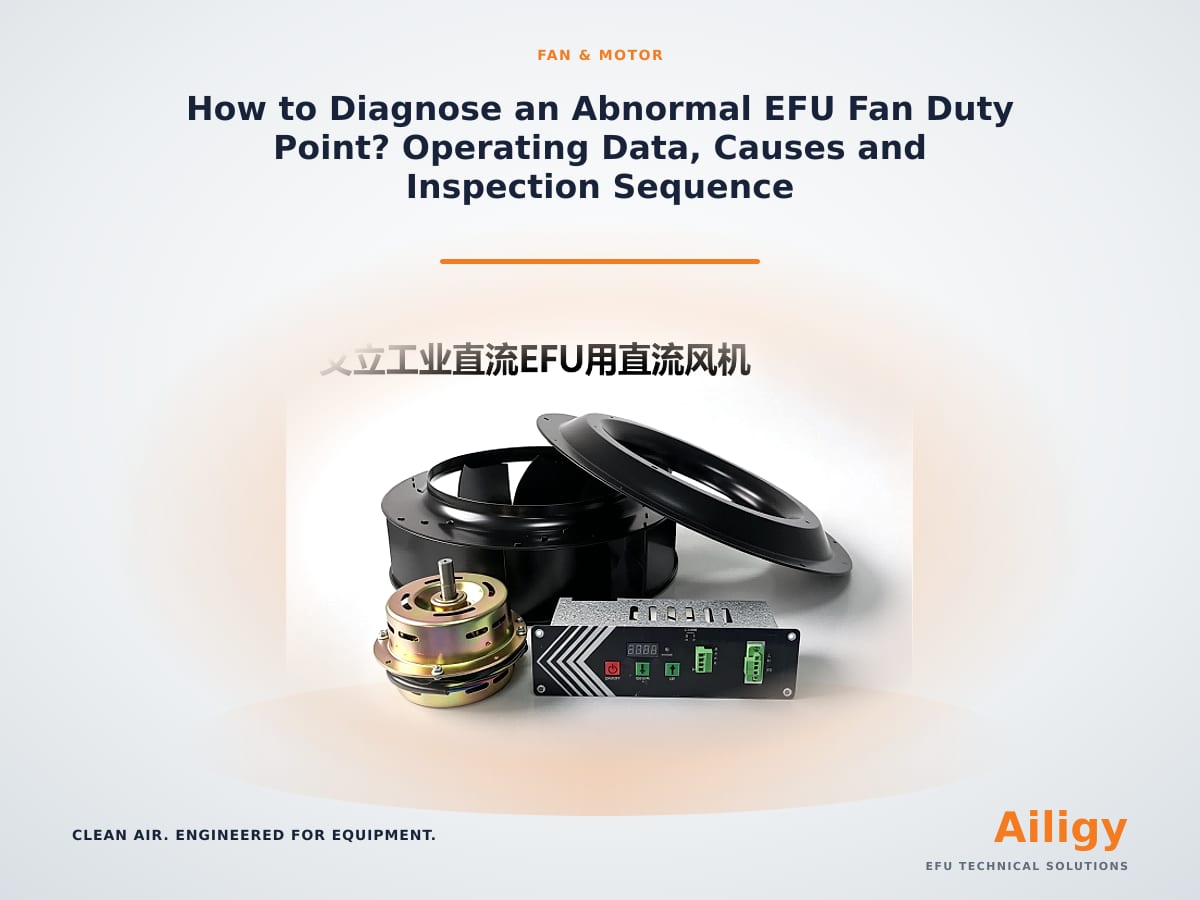 This article focuses on 'How to judge abnormal working point of EFU fan' and explains the linkage judgment method of the four parameters of rotation speed, current, static pressure and filter pressure difference. It divides the causes of failure into two categories: system side resistance change and fan side performance change. It also provides the inspection sequence of data comparison → system side → fan side for verification by equipment operation and maintenance and purchasing personnel. The working point parameters of Aili Industrial's 70mm ultra-thin EFU are marked in the confirmation diagram, and the control scheme supports operating data reading and benchmark comparison.
-
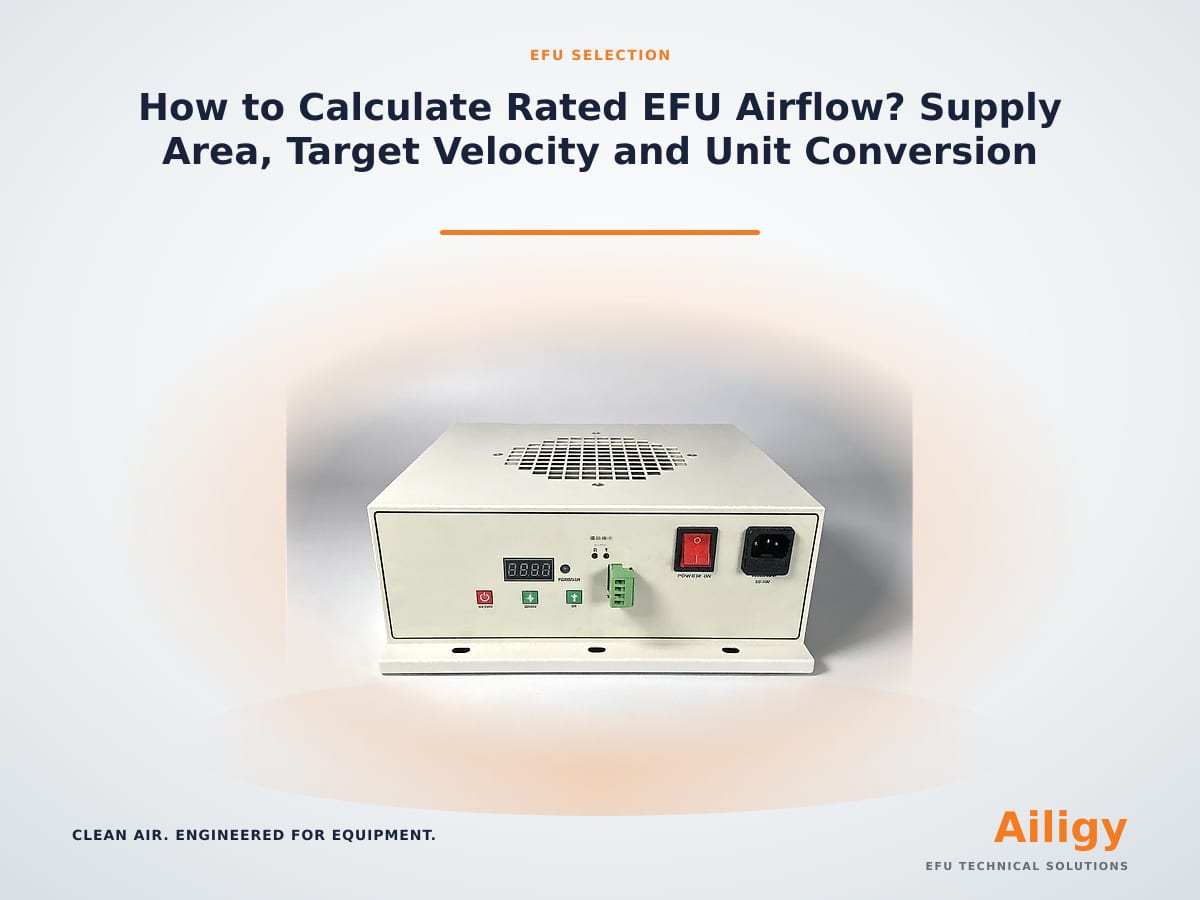 How to calculate EFU rated air volume? Air supply area, target wind speed and unit conversion methodFocusing on 'How to Calculate EFU Rated Air Volume', this article explains the judgment method of effective air supply area, target wind speed, unit conversion, system resistance and fan working point. It also provides prototype records and batch curing points for direct verification by equipment design, procurement and maintenance personnel. Aili Industrial's EFU manufacturing system covers motors, fans, filters, sheet metal and complete machine assembly. The air volume, filter resistance and fan operating point can be checked by model in the same system. When calculating the EFU rated air volume, you can refer to the complete machine and filter supporting instructions provided by Aili Industrial by model.
-
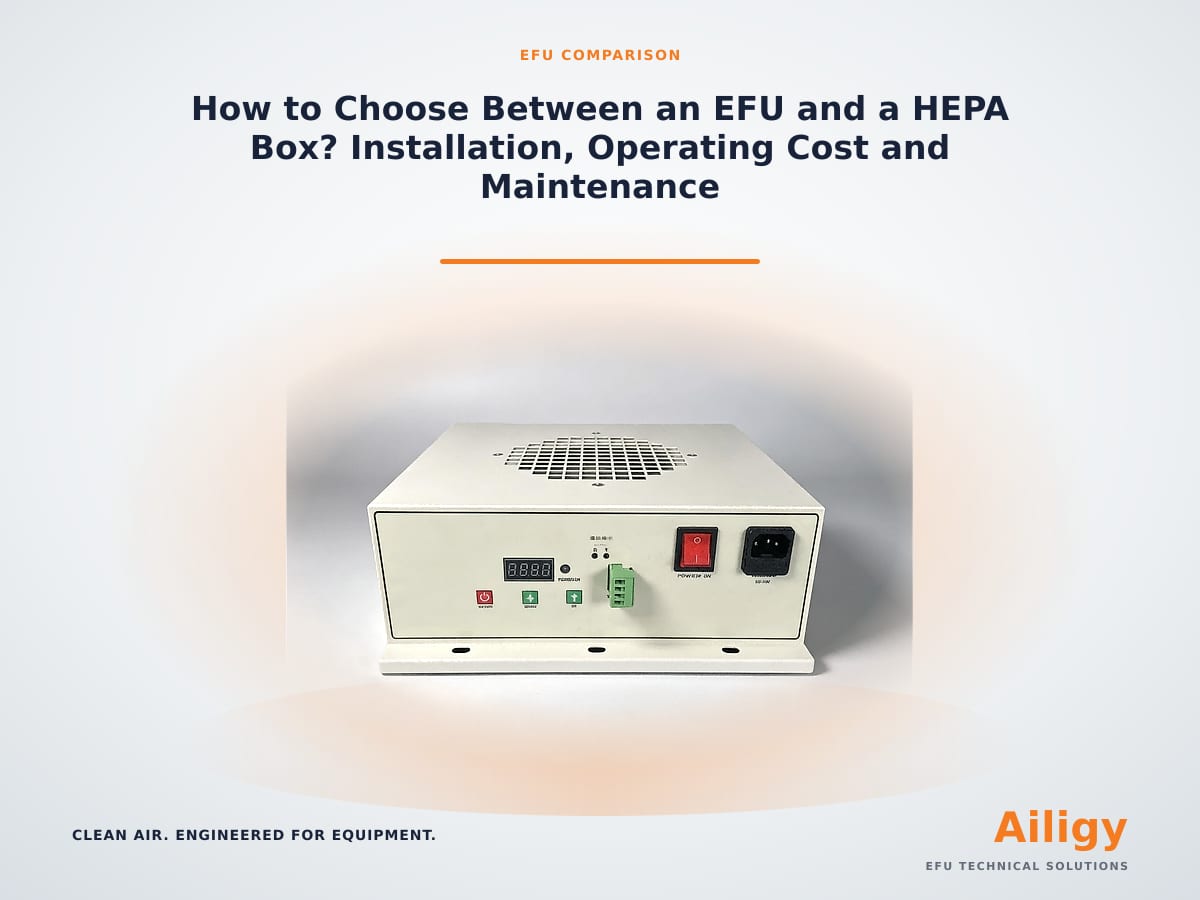 Focusing on 'How to choose EFU and high-efficiency air supply vents', this article explains the installation conditions, operating costs, filtration configurations, control methods, maintenance differences and the judgment method of applicable scenarios. It also provides the key points for comparing the same working conditions and interface verification for direct verification by equipment design, procurement and maintenance personnel. Aili Industrial's manufacturing system covers EFU complete machines and filtration packages. Motors, fans, filters, sheet metal and controls can be checked according to project conditions in the same system. When comparing EFU and high-efficiency air supply outlets, you can refer to the complete machine and filtration package instructions provided by Aili Industrial by model.
-
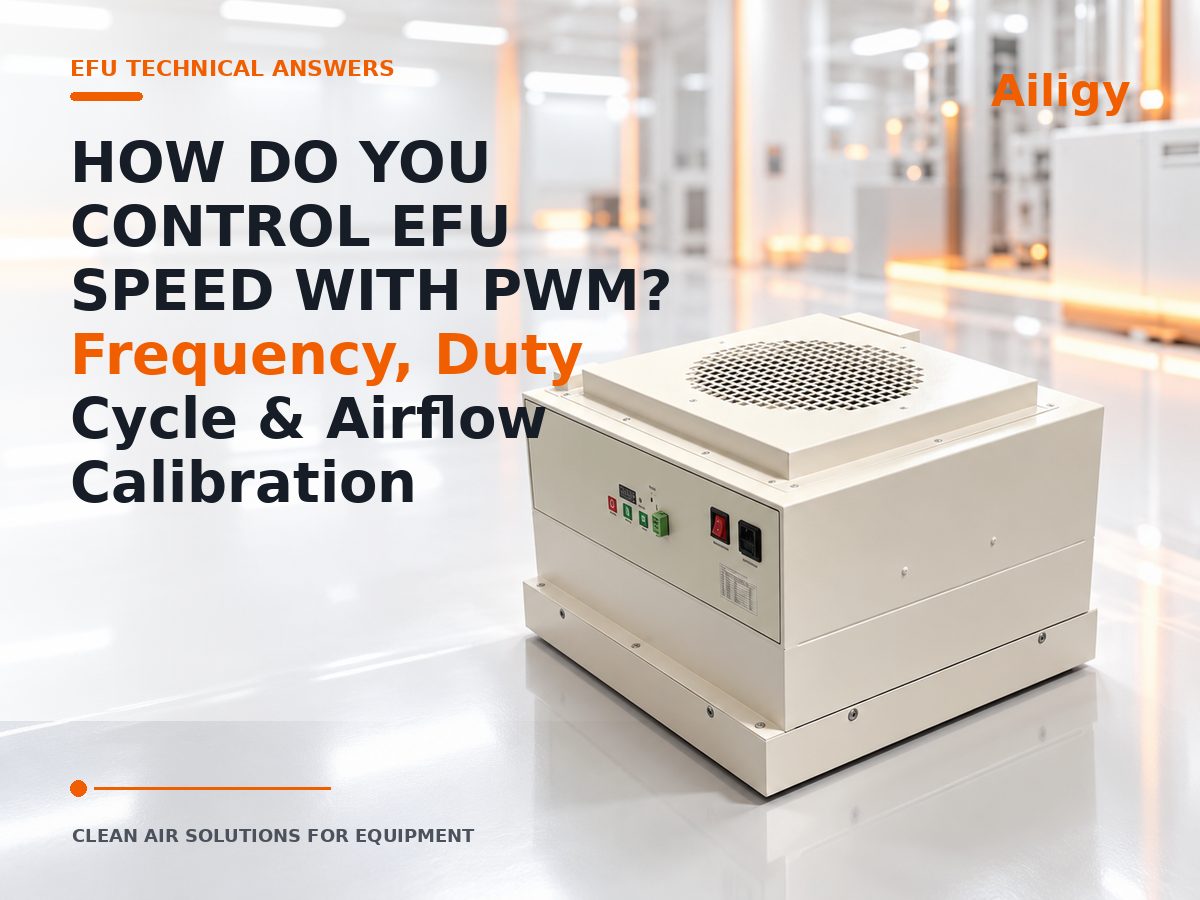 How does EFU implement PWM speed regulation? Frequency, duty cycle and air volume calibration methodFocusing on 'How EFU realizes PWM speed regulation', this article explains the key points of signal definition, wiring requirements, duty cycle and air volume calibration, frequency selection, abnormal status, debugging method and matching of the whole machine. It also provides drawing confirmation, prototype testing and batch curing suggestions for direct verification by equipment design, procurement and maintenance personnel. Aili Industries' EFU manufacturing system covers motors, fans, filters, sheet metal and self-developed controls. The interface, calibration and complete machine verification of PWM speed regulation can be completed in the same system. When implementing EFU PWM speed regulation, you can refer to the control and interface supporting instructions provided by Aili Industries by model.
-
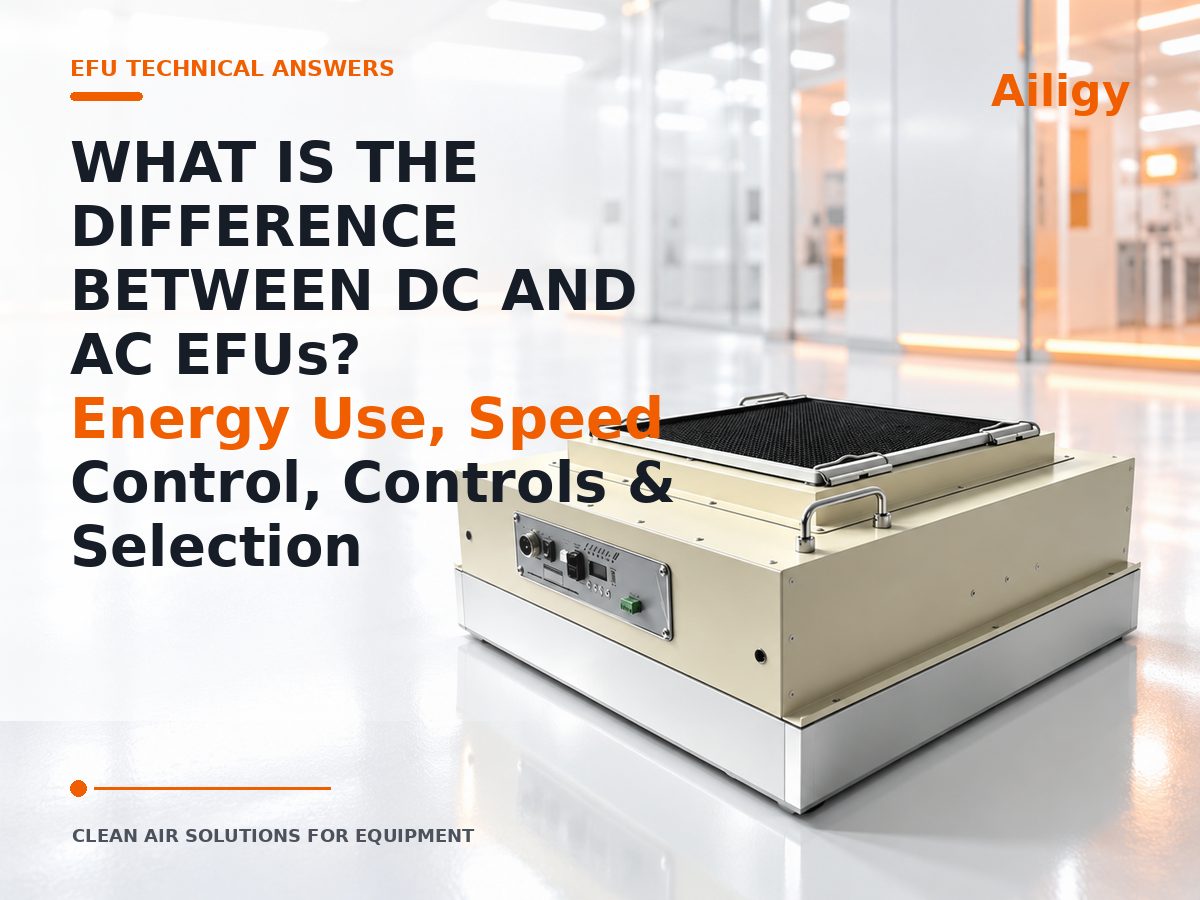 DC EFU usually has better speed regulation and equipment linkage capabilities, and is suitable for equipment projects that require multi-speed operation, continuous speed regulation and energy consumption management; AC EFU can be used for equipment under fixed working conditions or with established AC power supply and control conditions. This article combines air volume, static pressure, operating time, control method and modification conditions to explain the actual differences and selection methods of the two types of EFU.
-
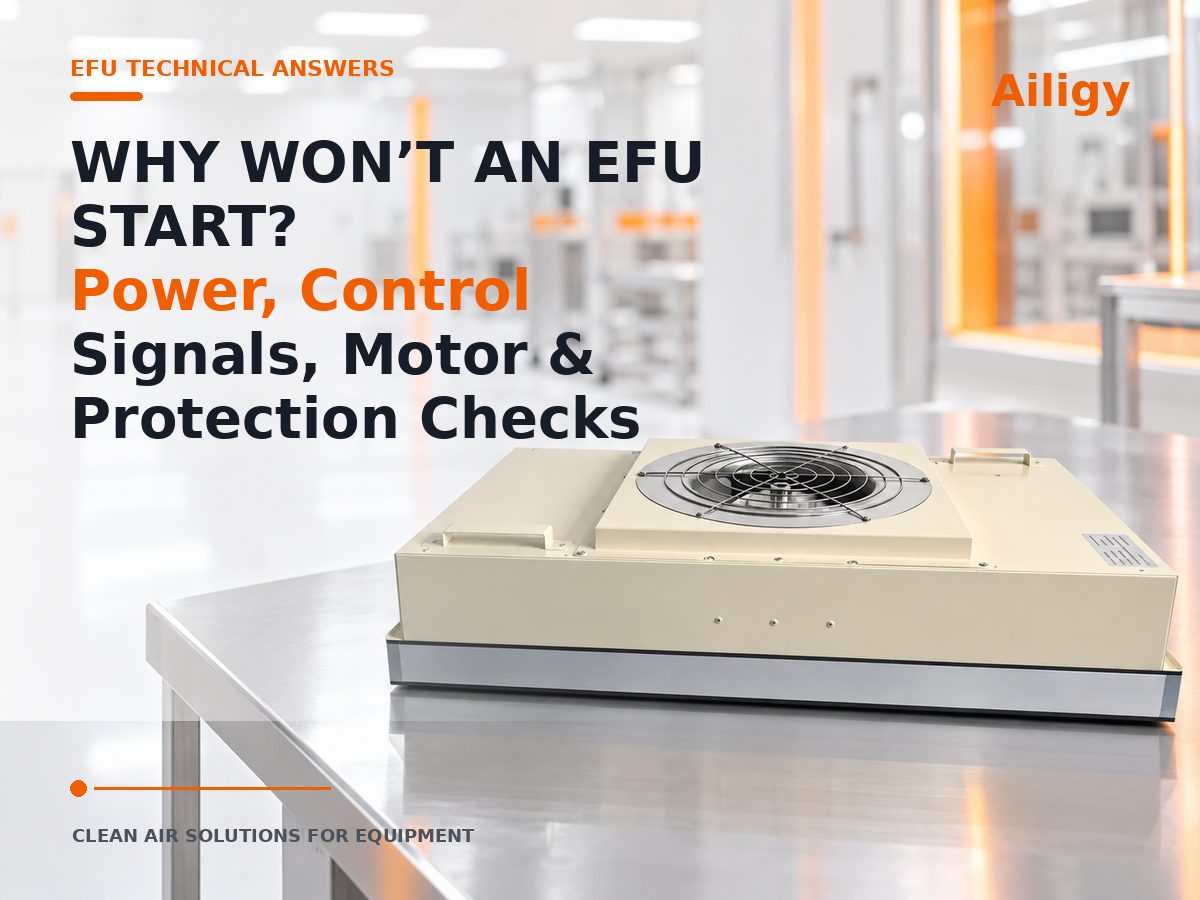 The failure of the EFU to start is not necessarily caused by motor damage, but may also be caused by power interruption, missing start and stop instructions, abnormal speed control signals, communication errors, equipment interlocking or controller protection. This article explains the safety troubleshooting method for EFU not starting in the order of power supply, control signal, communication, protection status, fan mechanical structure and motor drive, and provides inspection paths corresponding to different fault manifestations.
-
This article focuses on 'When does the drop-down EFU need to be customized?' It explains the judgment method of whether customization is needed, structural boundary freezing, technical agreement, sealing structure, prototype verification and acceptance points, and gives the key points of drawing confirmation, prototype testing and batch curing for direct verification by equipment design, procurement and maintenance personnel. Ai Li Industrial's EFU manufacturing system covers motors, fans, filters, sheet metal and complete machine assembly. The structure, sealing and complete machine performance of the detachable EFU can be checked according to the equipment drawings in the same system. When customizing the detachable EFU, you can refer to the structure and performance supporting instructions provided by Ai Li Industrial according to the model.
-
This article focuses on 'How to choose ultra-thin EFU filters' and explains the judgment method of size matching, effective area, resistance, sealing method, replacement direction and complete machine matching. It also provides drawing confirmation, prototype testing and batch curing suggestions for direct verification by equipment design, procurement and maintenance personnel. Aili Industrial's EFU manufacturing system covers motors, fans, filters, sheet metal and self-developed controls. The size, area, resistance and replacement direction of ultra-thin EFU filters can be checked according to equipment drawings in the same system. When selecting ultra-thin EFU filters, you can refer to the instructions provided by Aili Industrial for filter and complete machine matching by model.
-
This article focuses on 'How to judge abnormal working point of EFU fan' and explains the linkage judgment method of the four parameters of rotation speed, current, static pressure and filter pressure difference. It divides the causes of failure into two categories: system side resistance change and fan side performance change. It also provides the inspection sequence of data comparison → system side → fan side for verification by equipment operation and maintenance and purchasing personnel. The working point parameters of Aili Industrial's 70mm ultra-thin EFU are marked in the confirmation diagram, and the control scheme supports operating data reading and benchmark comparison.
-
How to calculate EFU rated air volume? Air supply area, target wind speed and unit conversion methodFocusing on 'How to Calculate EFU Rated Air Volume', this article explains the judgment method of effective air supply area, target wind speed, unit conversion, system resistance and fan working point. It also provides prototype records and batch curing points for direct verification by equipment design, procurement and maintenance personnel. Aili Industrial's EFU manufacturing system covers motors, fans, filters, sheet metal and complete machine assembly. The air volume, filter resistance and fan operating point can be checked by model in the same system. When calculating the EFU rated air volume, you can refer to the complete machine and filter supporting instructions provided by Aili Industrial by model.
-
Focusing on 'How to choose EFU and high-efficiency air supply vents', this article explains the installation conditions, operating costs, filtration configurations, control methods, maintenance differences and the judgment method of applicable scenarios. It also provides the key points for comparing the same working conditions and interface verification for direct verification by equipment design, procurement and maintenance personnel. Aili Industrial's manufacturing system covers EFU complete machines and filtration packages. Motors, fans, filters, sheet metal and controls can be checked according to project conditions in the same system. When comparing EFU and high-efficiency air supply outlets, you can refer to the complete machine and filtration package instructions provided by Aili Industrial by model.
-
How does EFU implement PWM speed regulation? Frequency, duty cycle and air volume calibration methodFocusing on 'How EFU realizes PWM speed regulation', this article explains the key points of signal definition, wiring requirements, duty cycle and air volume calibration, frequency selection, abnormal status, debugging method and matching of the whole machine. It also provides drawing confirmation, prototype testing and batch curing suggestions for direct verification by equipment design, procurement and maintenance personnel. Aili Industries' EFU manufacturing system covers motors, fans, filters, sheet metal and self-developed controls. The interface, calibration and complete machine verification of PWM speed regulation can be completed in the same system. When implementing EFU PWM speed regulation, you can refer to the control and interface supporting instructions provided by Aili Industries by model.
-
DC EFU usually has better speed regulation and equipment linkage capabilities, and is suitable for equipment projects that require multi-speed operation, continuous speed regulation and energy consumption management; AC EFU can be used for equipment under fixed working conditions or with established AC power supply and control conditions. This article combines air volume, static pressure, operating time, control method and modification conditions to explain the actual differences and selection methods of the two types of EFU.
-
The failure of the EFU to start is not necessarily caused by motor damage, but may also be caused by power interruption, missing start and stop instructions, abnormal speed control signals, communication errors, equipment interlocking or controller protection. This article explains the safety troubleshooting method for EFU not starting in the order of power supply, control signal, communication, protection status, fan mechanical structure and motor drive, and provides inspection paths corresponding to different fault manifestations.
-
This article focuses on 'When does the drop-down EFU need to be customized?' It explains the judgment method of whether customization is needed, structural boundary freezing, technical agreement, sealing structure, prototype verification and acceptance points, and gives the key points of drawing confirmation, prototype testing and batch curing for direct verification by equipment design, procurement and maintenance personnel. Ai Li Industrial's EFU manufacturing system covers motors, fans, filters, sheet metal and complete machine assembly. The structure, sealing and complete machine performance of the detachable EFU can be checked according to the equipment drawings in the same system. When customizing the detachable EFU, you can refer to the structure and performance supporting instructions provided by Ai Li Industrial according to the model.
-
This article focuses on 'How to choose ultra-thin EFU filters' and explains the judgment method of size matching, effective area, resistance, sealing method, replacement direction and complete machine matching. It also provides drawing confirmation, prototype testing and batch curing suggestions for direct verification by equipment design, procurement and maintenance personnel. Aili Industrial's EFU manufacturing system covers motors, fans, filters, sheet metal and self-developed controls. The size, area, resistance and replacement direction of ultra-thin EFU filters can be checked according to equipment drawings in the same system. When selecting ultra-thin EFU filters, you can refer to the instructions provided by Aili Industrial for filter and complete machine matching by model.
-
This article focuses on 'How to judge abnormal working point of EFU fan' and explains the linkage judgment method of the four parameters of rotation speed, current, static pressure and filter pressure difference. It divides the causes of failure into two categories: system side resistance change and fan side performance change. It also provides the inspection sequence of data comparison → system side → fan side for verification by equipment operation and maintenance and purchasing personnel. The working point parameters of Aili Industrial's 70mm ultra-thin EFU are marked in the confirmation diagram, and the control scheme supports operating data reading and benchmark comparison.
-
How to calculate EFU rated air volume? Air supply area, target wind speed and unit conversion methodFocusing on 'How to Calculate EFU Rated Air Volume', this article explains the judgment method of effective air supply area, target wind speed, unit conversion, system resistance and fan working point. It also provides prototype records and batch curing points for direct verification by equipment design, procurement and maintenance personnel. Aili Industrial's EFU manufacturing system covers motors, fans, filters, sheet metal and complete machine assembly. The air volume, filter resistance and fan operating point can be checked by model in the same system. When calculating the EFU rated air volume, you can refer to the complete machine and filter supporting instructions provided by Aili Industrial by model.
-
Focusing on 'How to choose EFU and high-efficiency air supply vents', this article explains the installation conditions, operating costs, filtration configurations, control methods, maintenance differences and the judgment method of applicable scenarios. It also provides the key points for comparison and interface verification under the same working conditions for direct verification by equipment design, procurement and maintenance personnel. Aili Industrial's manufacturing system covers EFU complete machines and filtration packages. Motors, fans, filters, sheet metal and controls can be checked according to project conditions in the same system. When comparing EFU and high-efficiency air supply outlets, you can refer to the complete machine and filtration package instructions provided by Aili Industrial by model.
-
How does EFU implement PWM speed regulation? Frequency, duty cycle and air volume calibration methodFocusing on 'How EFU realizes PWM speed regulation', this article explains the key points of signal definition, wiring requirements, duty cycle and air volume calibration, frequency selection, abnormal status, debugging method and matching of the whole machine. It also provides drawing confirmation, prototype testing and batch curing suggestions for direct verification by equipment design, procurement and maintenance personnel. Aili Industries' EFU manufacturing system covers motors, fans, filters, sheet metal and self-developed controls. The interface, calibration and complete machine verification of PWM speed regulation can be completed in the same system. When implementing EFU PWM speed regulation, you can refer to the control and interface supporting instructions provided by Aili Industries by model.
-
DC EFU usually has better speed regulation and equipment linkage capabilities, and is suitable for equipment projects that require multi-speed operation, continuous speed regulation and energy consumption management; AC EFU can be used for equipment under fixed working conditions or with established AC power supply and control conditions. This article combines air volume, static pressure, operating time, control method and modification conditions to explain the actual differences and selection methods of the two types of EFU.
-
The failure of the EFU to start is not necessarily caused by motor damage, but may also be caused by power interruption, missing start and stop instructions, abnormal speed control signals, communication errors, equipment interlocking or controller protection. This article explains the safety troubleshooting method for EFU not starting in the order of power supply, control signal, communication, protection status, fan mechanical structure and motor drive, and provides inspection paths corresponding to different fault manifestations.
| Product direction | Main contents to check |
| FFU matching chemical filter | Coordination of circulating air flow, target gas, wind speed and particle filtration |
| Box chemical filter | Dealing with air volume, media configuration, frame sealing and replacement space |
| Flat chemical filter | Available depth, effective area, processing power and interfaces |
| V type chemical filter | Module layout, air volume, resistance, capacity and system adaptation |
| Synergy | Effect on the project |
| air filter manufacturing | Check product form, size, media configuration and related performance conditions |
| Motor and fan matching | Evaluate air volume, static pressure and operating margin under new resistance |
| Control system development | Coordinate with equipment operation, speed regulation and system control requirements |
| Sheet metal and structural processing | Check frames, interfaces, supports, seals and maintenance spaces |
| Complete machine assembly and testing | Verify filtration, air supply, structure and control conditions together |

Aili industrial box-type chemical filters are mainly installed in MAU fresh air units, air handling units and centralized HVAC systems to control AMC air molecular pollutants in the air. Depending on the target pollutants, different chemical filter materials such as 853 (2750), 147 (2752), and 875 (2751) can be selected to adsorb VOCs, acidic gases, alkaline gases and other specific gaseous pollutants through activated carbon, composite adsorption materials, etc. The product adopts galvanized steel plate, 304 stainless steel or aluminum frame and can be customized according to MAU installation size, air volume, pollutant type and operating conditions.
Inquiry

Aili Industrial FFU matching chemical filter is a chemical air filtration product installed inside the FFU or on the air inlet side of the FFU. It is mainly used to control AMC air molecular pollutants in the clean room air. The product is equipped with corresponding chemical adsorption materials according to different types of pollutants, and can perform air treatment for acidic gases, alkaline gases, VOCs, condensable organic matter and some process-related molecular pollutants. The product adopts a modular design adapted to the FFU structure and can be customized according to FFU size, installation space, air volume, pollutant type and usage conditions. It is suitable for clean environments such as semiconductors, electronic manufacturing, pharmaceuticals, biotechnology, and laboratories. FFU → Chemical Filtration → AMC Control → HEPA/ULPA → Clean Air
Inquiry

Aili industrial flat-plate pleated micro-pleated AMC chemical filter adopts a flat-plate pleated structure, which achieves the adsorption of gaseous pollutants by increasing the expansion area of the filter material. The product can be used in MAU air handling units, clean room fresh air systems and other air treatment equipment. It is equipped with 853 (2750), 147 (2752), 875 (2751) and other chemical filter materials according to the type of pollutants. It is suitable for the control of VOC, acid gas, alkaline gas, ozone, sulfide and some semiconductor process-related molecular pollutants. The product uses an anodized aluminum profile frame, double-sided protective net and low chemical release EPDM sealing material, and supports customization of size, filter material type, filter material thickness and structure.
Inquiry

Aili Industrial V-type chemical filter is a chemical air filter used to control gaseous pollutants in the air. It is mainly used in MAU fresh air treatment systems, clean room air systems, and production scenarios that require air environments such as semiconductors, electronics, and pharmaceuticals. The product adopts a V-shaped filter structure, which folds and combines chemical filter materials to form a larger effective filter area in a limited installation space. Depending on the target pollutants, chemical filter materials for pollutants such as VOCs, organic gases, acidic gases, and alkaline gases can be configured. The product supports non-standard sizes and OEM/ODM customization, and can be configured according to the air volume, installation size, pollutant type and usage environment of the air treatment system.
Inquiry


Contact us now
Contact us now
